Everything you can monitor
30 check types, run from regions around the world — the way your users reach you. One platform, one confirmed alert when something actually breaks.
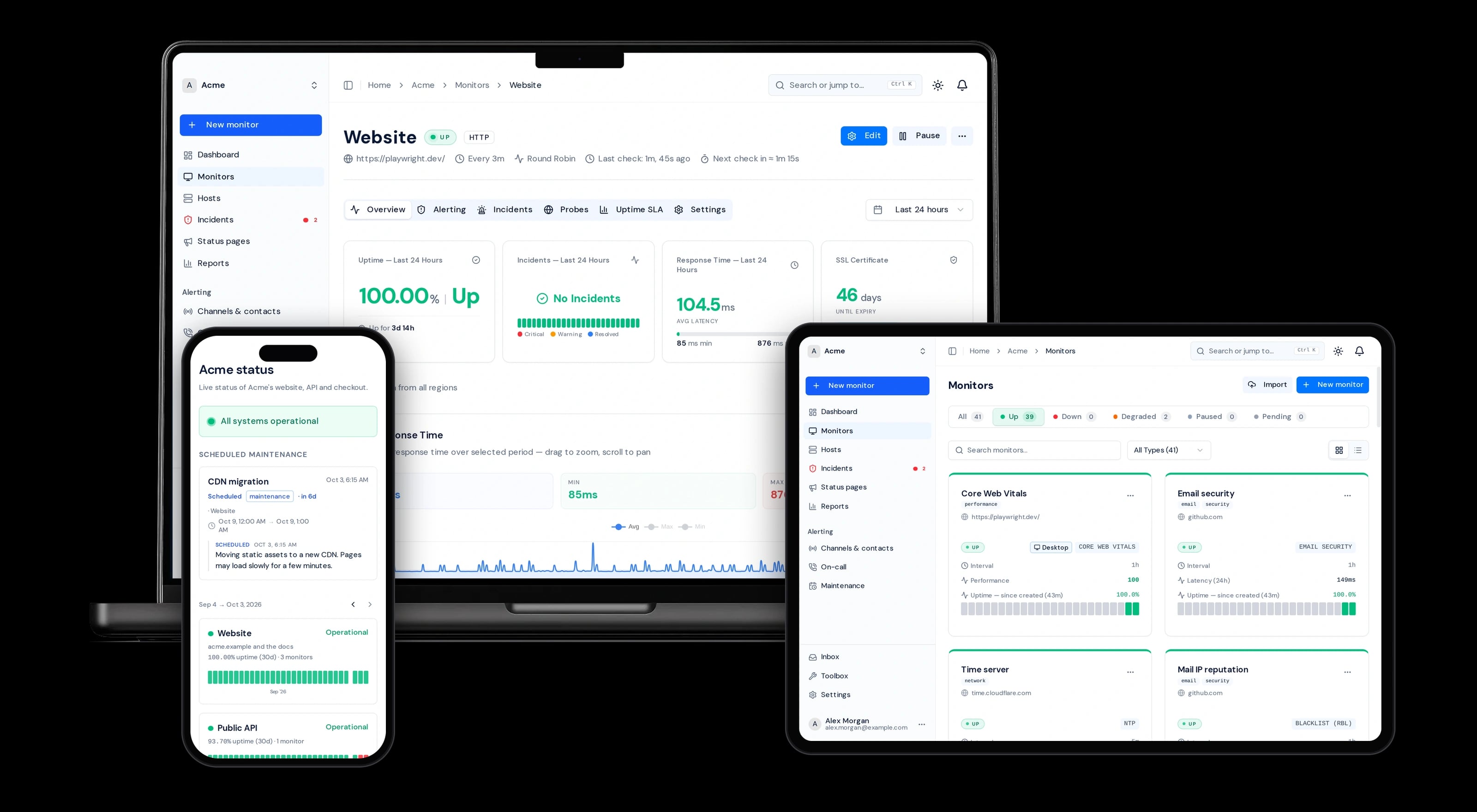
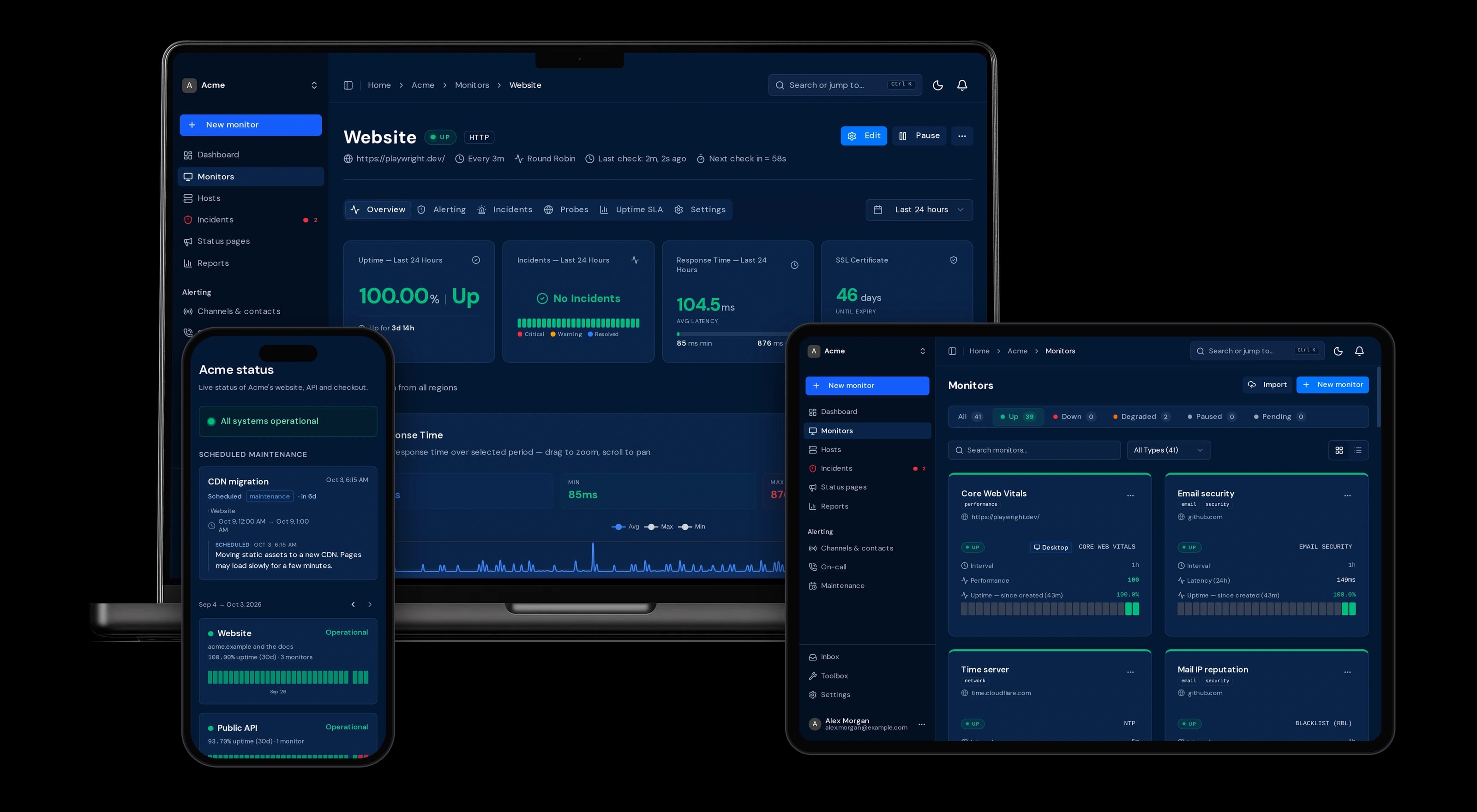
HTTP/HTTPS Monitoring
Checks that your website, store or app is up and loading fast — and that pages actually return what they should.
Key features
- Uptime, status codes and response time from multiple regions
- Content validation — catch “200 OK but broken” pages
- Custom headers, auth and request methods for APIs
Playwright Browser Checks
Runs your real Playwright test on a schedule, step by step: can a customer still sign in, search and check out?
Key features
- Plain Playwright Test code that also runs on your laptop
- Per-step timings, screenshots and a full Playwright trace
- A retry and a confirmation run before anyone is paged
API Monitoring
Checks that an API answers correctly, not just that it answers: status, headers and JSON fields asserted on every check.
Key features
- Assertions on JSON fields, headers, status and body
- Values extracted from the response and charted over time
- Auth headers, methods and request bodies for real endpoints
Heartbeat Monitoring
Your workers and services ping us when they run — you get alerted the moment one goes silent.
Key features
- One curl line per service — no agent, no SDK
- Windows from 1 minute to 365 days, with grace
- Exit codes, run durations and job output on every ping
Cron Job Monitoring
Know the night a scheduled job doesn't run — real cron expressions, timezones and grace included.
Key features
- Same 5-field cron line your crontab uses, timezone-aware
- “Didn't run”, “failed” and “ran too long” alert separately
- Job output attached to each run for instant diagnosis
MCP Server Monitoring
Protocol-level checks for Model Context Protocol servers — handshake, tool inventory and rug-pull drift detection.
Key features
- Real initialize handshake + version negotiation
- Full tools/list fingerprint on every check
- Alerts with the exact tool diff on any change
WebSocket Monitoring
Opens real WebSocket connections to make sure your live features — chat, feeds, dashboards — actually connect.
Key features
- Full ws:// and wss:// handshake checks
- Ping/pong liveness with round-trip timing
- Optional message pattern matching
TCP Port Monitoring
Makes sure the services behind your site — databases, mail servers, SSH — are reachable and accepting connections.
Key features
- Any TCP port — databases, mail, SSH, custom services
- Connect-time tracking and trends over time
- Multi-region confirmation before an alert fires
UDP Monitoring
Availability checks for services that talk over UDP, like time servers, DNS or game servers.
Key features
- NTP, DNS, game and custom UDP services
- Payload and response validation
- Verifies real answers — not just a powered-on server
NTP Monitoring
Checks your time servers stay accurate — offset, jitter and sync status, not just "is it up".
Key features
- Measures clock offset, jitter and stratum
- Alerts on drift and lost sync, not just downtime
- Public pools or your own time servers
DNS Monitoring
Watches the DNS records that point people to your site, and warns you if they change or stop working.
Key features
- A, AAAA, CNAME, MX and TXT record checks
- Instant alerts on unauthorized record changes
- Resolution failures and slow lookups across regions
SSL Certificate Monitoring
Keeps an eye on your HTTPS certificates so visitors never see a scary “not secure” warning.
Key features
- Expiry warnings weeks ahead, on your schedule
- Full certificate chain and handshake validation
- Covers every HTTPS endpoint you monitor
Ping (ICMP) Monitoring
A simple “is it reachable?” check for any server, with response time and packet loss.
Key features
- Reachability, latency and packet loss for any host
- Region-by-region comparison — local vs global issues
- IPv4 and IPv6 checks
MTR / Network Path Monitoring
Traces the whole network route to your server, step by step, when things get slow.
Key features
- Hop-by-hop route, latency and loss (ping + traceroute)
- Pinpoints the exact hop where problems start
- Made for “slow but not down” investigations
SMTP Monitoring
Checks that your mail server is up and ready to send and receive.
Key features
- Mail server availability and connect time
- STARTTLS and open relay checks
- Optional login check on 587 or 465, with certificate expiry
IMAP Monitoring
Logs in to a mailbox over IMAP: alerts when login, TLS or new mail stops working, or before the mailbox fills up.
Key features
- Read-only login, message and folder counts
- TLS version, certificate expiry and an A+ to F grade
- Alerts before the mailbox fills up, or when new mail stops
POP3 Monitoring
Logs in to a POP3 mailbox like a help desk would, without downloading mail.
Key features
- Login, message count and mailbox size
- TLS version, certificate expiry and an A+ to F grade
- Alerts when the newest message gets too old
Email Round-Trip Monitoring
Sends a test email and finds it in the mailbox: delivery time, Inbox or Spam.
Key features
- Delivery time and Inbox vs Spam placement
- SPF, DKIM and DMARC as the receiver saw them
- Every relay hop with its delay and TLS
FTP Monitoring
Connects to your FTP servers so partner uploads and scheduled transfers keep working.
Key features
- Real sessions: connect, login, directory listing
- Optional write and throughput tests
- Stage timings show exactly what's slow
SFTP Monitoring
Watches the secure (SSH) file servers that move payroll, banking and partner files on deadlines.
Key features
- Full SSH handshake and login verification
- Optional listing, write and throughput tests
- Availability history for audits and SLAs
Email Deliverability Monitoring
Watches the settings (SPF, DKIM, DMARC) that keep your emails out of spam folders.
Key features
- SPF, DKIM and DMARC policy validation
- Alerts when a change risks deliverability
- Guards against spoofing misconfiguration
Domain Expiry Monitoring
Tracks when your domain registration runs out.
Key features
- Expiry tracked from official registry data
- Warnings weeks before a domain lapses
- Renewal picked up automatically after you renew
CDN Monitoring
Confirms your CDN is doing its job and actually speeding up your site.
Key features
- Verifies your CDN is present and serving
- Detects traffic silently bypassing the CDN
- Edge behaviour checked from multiple regions
Compression Monitoring
Checks your pages still come back Brotli-compressed, so they load faster on every device.
Key features
- Checks Content-Encoding: br on every run
- Flags URLs that stop coming back with Brotli
- Brotli supported rate over time
Core Web Vitals Monitoring
Measures how fast your pages feel to real visitors — the same Core Web Vitals scores Google uses for ranking.
Key features
- LCP, CLS, TBT and Lighthouse scores over time
- Real browser audits, desktop or mobile profile
- Screenshot and full report on every run
Sitemap Monitoring
Checks your sitemap loads and a sample of the pages listed in it still work.
Key features
- Finds your sitemap and counts its URLs
- Detects broken URLs among up to 50 listed pages
- Catches issues before search engines do
Favicon Monitoring
Makes sure the little icon in the browser tab is present and served as a real image.
Key features
- Catches icons lost in deploys and CDN moves
- Content-type and size validation
- Checked from the regions you choose
Blacklist Monitoring
Checks whether your mail server's IP has landed on spam blocklists.
Key features
- Checks major spam blocklists (DNSBL/RBL)
- Spamhaus, Barracuda, SpamCop or your own lists
- Early warning before email starts bouncing
Keyword / Content Monitoring
Watches a page for text that should be there — or text that shouldn't.
Key features
- Require text that must be present — or must not be
- Catches defacement and silent “broken but 200” pages
- Works on any page you already monitor
CMS Monitoring
Detects which of 60 platforms a site runs and alerts when it stops matching the one you expect.
Key features
- Detects WordPress, Drupal and other platforms
- Assert an expected platform — mismatch alerts
- Great for migrations and client portfolios
Data Breach Monitoring
Watches the Have I Been Pwned catalog for new breaches involving your domain.
Key features
- Matches breaches by domain, subdomains included
- Alerts when a new matching breach is published
- Watch your vendors' domains too
Page Integrity Monitoring
Alerts when key pages differ from an accepted baseline: injected scripts, hijacked forms, spam links, weakened headers.
Key features
- New script sources and changed script code, by origin
- Form targets, redirects, tamper words and security headers
- Optional real-browser checks with screenshots as evidence
Beyond the checks
Every monitor plugs into the same platform: confirmed incidents, alert routing and public status pages.
Status Pages
A public status page on your own subdomain — incidents, maintenance and uptime history your customers can follow.
Learn moreIncident Management
Confirmed incidents with acknowledgement, internal notes and a clean timeline from firing to resolved.
Learn moreAlerting Integrations
Notification channels — email, Slack, Telegram, Discord, PagerDuty and webhooks — routed to the right people.
Learn moreStart watching in minutes
Create your free account — no credit card required.